
How to Identify Original vs Duplicate Marble
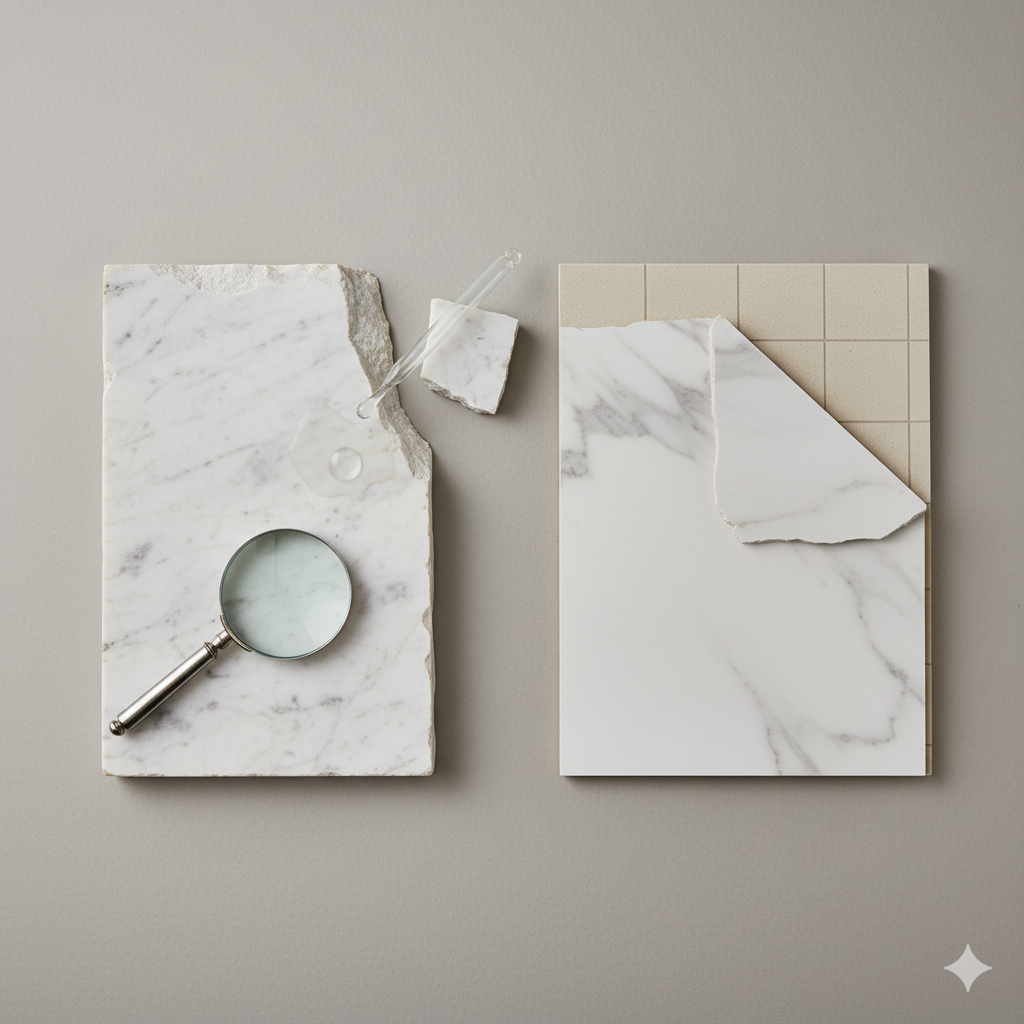
How to Identify Original vs Duplicate Marble
Introduction
Choosing marble is a long term decision because floors, walls, and counters are not replaced often. The challenge today is that high quality prints and engineered surfaces can imitate the look of natural stone closely enough to confuse even careful buyers. In the Indian market you will encounter many categories presented during selection. There are genuine marble slabs fresh from the quarry that show natural variation. There are composite products made from stone dust and resin that try to pass as marble. There are porcelain tiles with inkjet prints that repeat every few pieces. Some sellers may also offer heavily resin filled or dyed lots as first quality. The result is uncertainty and the risk of paying a premium for something that will not age like real marble.
This guide exists to remove that uncertainty. You will learn quick visual filters you can apply the moment you enter a yard, like scanning for pattern repetition and checking the back of a piece. You will practise close inspection techniques that reveal factory repairs, color touch ups, and printed faces. You will see safe field tests for the unpolished edge or an offcut so you never damage a finished surface. You will know which documents to insist on, how to control lots with tagging and photographs, and how to structure payments so last minute swaps are impossible. Finally, you will follow a simple buying workflow that keeps your project protected from selection to delivery to installation. With these steps you can enjoy the depth, randomness, and quiet glow that only authentic marble delivers.
Index
- Why fakes exist and what they look like
- First glance checks that filter out obvious duplicates
- Close inspection in the showroom
- Safe field tests on site before installation
- Documents and supplier verification that prove authenticity
- Dimensional and build quality checks
- Price red flags and deal structure
- Buying workflow checklist you can follow today
- FAQs
- Conclusion
Why fakes exist and what they look like
Demand for marble is high and budgets vary which creates space for substitutes. Some sellers present porcelain tiles, engineered quartz, composite marble, or even printed laminates as if they were real stone. Porcelain shows a printed pattern that repeats every few pieces. Engineered quartz feels warmer to the touch and more uniform than marble. Composite marble mixes stone dust with resin and often shows air bubbles or a sugary uniform look. Knowing these categories helps you ask the right questions from the start.
First glance checks that filter out obvious duplicates
Stand back and look for repetition. Natural marble has random movement. If you see the same flower-like knot or a very similar swirl appearing again and again across pieces, it is probably printed or engineered.
Check the back of the piece. A porcelain tile has a biscuit-like ceramic back. Composite marble may have a grid or mesh and looks man made at the cut edges. A true marble slab shows crystalline stone from face to back.
Watch the way light moves. Real marble has depth that shifts as you move. Printed surfaces look flat and the light sits on top rather than inside the stone.
Close inspection in the showroom
Look at cut edges and corners with a small torch or the phone light. Natural marble reveals crystals and fine variation. Duplicates show a printed layer on top or a very uniform composition. Run your fingers across the face. Resin heavy or filled pieces feel plasticky and overly smooth even in a honed finish.
Search for filled holes and dyed patches. Many stones are repaired in a factory which is acceptable when declared. What you want to avoid is heavy resin work or color touch ups that change the look later.
Ask for multiple slabs from the same lot. Real lots show variation from slab to slab while staying within a family. If every piece looks identical, it is a warning sign.
Safe field tests on site before installation
Perform tests only on the unpolished back edge or on an offcut and ask permission from the seller.
Water drop test. Place a few drops of clean water on an offcut. Real marble darkens slowly as the water is absorbed and returns to normal as it evaporates. Impermeable printed or glazed surfaces show no change.
Gentle acid reaction test. A tiny drop of household vinegar on the rough back edge can create mild fizz on calcite rich marble. Wipe immediately with clean water. Do not do this on the finished face and do not use strong acids.
Sound test. Tap two pieces together. Natural marble produces a clear ringing tone. Porcelain and composites often sound dull.
Temperature touch. Marble usually feels cool to the touch at room temperature while many engineered surfaces feel neutral or slightly warm.
Documents and supplier verification that prove authenticity
Insist on a proper tax invoice in the correct business name with the exact stone name, thickness, finish, and quantity.
Ask for the lot number and photographs of the slabs you approved. This prevents last minute swaps.
For imported stones request the basic import details and an origin declaration. For Indian stones ask for the quarry name or region.
If available, request standard lab data such as water absorption and density. You do not need a technical degree to read it. Consistent figures across the lot indicate proper grading.
Work with a supplier that allows slab tagging and site delivery checks. Transparency is a strong quality signal.
Dimensional and build quality checks
Measure thickness with a vernier or thickness gauge. Floors and cladding are commonly in the range of eighteen to twenty millimetres while counters are usually in the range of twenty to thirty millimetres. Major deviation across a lot leads to uneven laying and poor polishing.
Check for warping or bowing by placing the slab on a flat reference.
Inspect the polish or hone quality under raking light. The surface should appear even with no waves or burns.
Check edges for chips and cracks. Micro chips at corners are common during handling but they must be declared and repairable without visible scars.
Price red flags and deal structure
Unusually low prices for popular names should trigger more questions. Sometimes a different stone is being sold under a premium name or heavy repair work is hidden with temporary polishing.
Avoid paying the full amount before you tag slabs. A sensible structure is a booking amount after selection and the balance after fabrication checks.
Ask about replacement policy for broken pieces in transit. Good suppliers declare this upfront which shows professional intent.
Buying workflow checklist you can follow today
Define your look and shortlist two or three stones that fit the room.
Visit the yard and view full slabs in daylight. Never decide only from a small sample.
Approve a vein layout drawing especially for book matched walls and long passages.
Tag the exact slabs with photographs and lot numbers.
Confirm thickness, finish, and edge profiles in writing.
Request invoice and supporting documents.
Before laying begins, repeat quick checks on site and keep one offcut aside for any future matching.
FAQs
- Which test is best to tell original marble from duplicate quickly?
Pattern repetition is the fastest filter. Natural marble never repeats exactly. Follow it with a look at the back of the piece. A ceramic or glazed back points to porcelain. - Can I rely on the vinegar fizz test alone?
Use it only as a gentle supporting check on an offcut or the rough back edge and wipe immediately. Do not use strong acids and never test on the finished face. - How do I confirm the seller will deliver the same slabs I selected?
Tag the slabs, record lot numbers, and take clear photos. Insist on the same lot in the invoice and check at delivery before installation. - Are resin filled repairs a problem?
Minor factory repairs are common and acceptable when disclosed. Avoid pieces with heavy resin patches or uneven colour as they age poorly. - What paperwork should I ask for?
A proper tax invoice with exact stone name, thickness, finish, quantity, and lot details. For imports, a basic origin note. For Indian stones, the quarry name or region. Keep photos of tagged slabs with the paperwork.
Conclusion
Original marble rewards you twice. First, at installation when the room suddenly feels larger and calmer because light enters the stone rather than bouncing off a print. Second, over time when the surface can be re polished and renewed instead of looking tired or delaminating. To reach that outcome, treat selection like a process rather than a quick purchase. Begin with big picture filters such as scanning for repeating patterns and checking the back of each piece. Move to close inspection of edges, filled areas, and overall variation across the lot. Use only safe field tests on an offcut or the unpolished back edge and record what you see. Control the paperwork with clear invoices, lot numbers, and slab photographs so the exact pieces you approved are the ones that arrive on site. Measure thickness, confirm finish quality under raking light, and protect edges during handling. Keep one offcut aside for future repairs or matching.
When you combine these steps, you remove guesswork from the buying experience and safeguard your project budget. The slabs that reach your home will be the slabs you chose, and the floors, walls, and counters will age with the quiet character that makes natural marble special.
Leave a Reply