
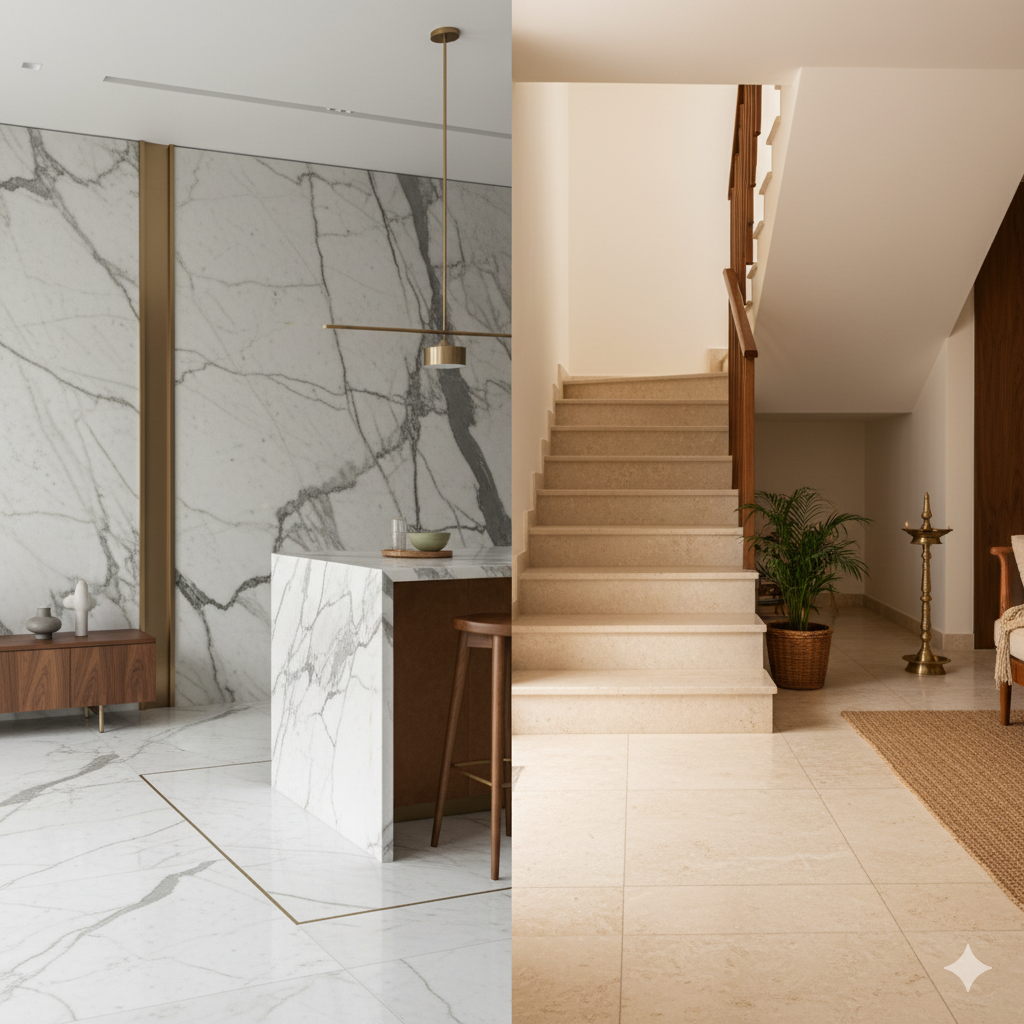
Difference Between Italian Marble and Indian Marble
Â
Introduction
The decision between Italian marble and Indian marble shapes how your home looks and how it feels to live in every day. On one side you have luminous whites and expressive veins that can turn a simple wall into a work of art. On the other you have warm creams and elegant beiges that create calm, uniform floors and stand up well to daily life in Indian conditions. Real homes deal with bright sun in some rooms and low light in others, with dust and festival foot traffic, with oil based cooking and quick clean ups, and with the need for surfaces that look premium yet do not demand constant worry. That is why the right answer is not just about the name of the stone. It is about the role of that stone in each room, the finish you choose, and the way the slabs are planned and installed.
This guide explains the difference between Italian and Indian marble in plain language. You will learn how color and veining change the mood of a room, how porosity and finish affect daily use, how slab sizes and thickness influence design freedom, and how price connects to lifetime value rather than only to the first invoice. You will also see where Italian marble truly shines such as a living room feature wall or a spa like bath and where Indian marble delivers long term comfort such as large floors, passages, and stairs. Most important, you will pick up a simple method to blend both in a single home so that the look is luxurious, the maintenance is realistic, and every space feels intentional from the first day.
Index
- Quick verdict for busy homeowners
- Appearance and veining that shape the mood of a room
- Durability, porosity, and daily use in Indian conditions
- Sizes, thickness, and availability that affect design freedom
- Price and lifetime value with practical budgeting ideas
- Best rooms for Italian marble and for Indian marble
- Finish choices that change both look and maintenance
- Installation planning that decides the final result
- Sustainability, sourcing, and responsible selection
- Buying checklist before you approve cutting
- FAQs
- Conclusion
Quick verdict for busy homeowners
Choose Italian marble when you want a showpiece wall or a statement zone that feels like a gallery. The veins are expressive and the whites glow. Choose Indian marble when you want large calm floors, easier daily care, and dependable value. For most homes, a blended plan works best. Use Italian marble for selected features and Indian marble for large floor areas. You get the wow where it matters and comfort where you live every day.
Appearance and veining that shape the mood of a room
Italian marble such as Statuario, Calacatta, and Carrara offers bright whites with bold or feathery grey movement. The effect is luminous and modern and suits book matched walls, double height lobbies, and spa like bathrooms.
Indian marble such as Makrana, Katni, Ambaji, Udaipur Green, and Jaisalmer gives warm creams, beiges, and earthy tones with tighter grains. Floors read calm and uniform and daily dust is less visible than on pure whites. When your furniture leans warm and your palette includes wood and brass, Indian marble blends beautifully.
Durability, porosity, and daily use in Indian conditions
Both Italian and Indian marbles are strong when installed correctly. The polished face of any marble can etch from acids like lemon and vinegar and can absorb oils if spills sit. Italian white marbles reward careful use and regular sealing since their bright base makes marks more noticeable. Many Indian marbles feel forgiving in day to day life because their tone and grain hide micro wear better. For kitchens and heavy traffic floors, finish choice matters as much as the stone itself. A honed or leathered finish softens light, improves grip, and disguises minor etching far better than a mirror shine.
Sizes, thickness, and availability that affect design freedom
Italian slabs are often available in larger formats which helps with book matching and long, uninterrupted wall panels. Indian stones are widely available in many sizes which reduces cutting waste on mass flooring. For floors and wall cladding, most homes use thickness in the range of eighteen to twenty millimetres. For kitchen and vanity counters, thickness in the range of twenty to thirty millimetres feels substantial and allows comfortable edge profiles.
Price and lifetime value with practical budgeting ideas
Italian marble carries a premium due to quarry selection, grading, import, and the visual prestige it brings to a room. It shines when you spend on highlight zones rather than across every surface. Indian marble offers excellent value for entire apartment floors, staircases, and commercial traffic. A blended plan is usually the smartest spend. Keep Italian marble for the foyer wall, television wall, master bath feature, or a few selected floor panels. Lay Indian marble across large floors and passages. You achieve a luxurious home without stretching the budget or the maintenance routine.
Best rooms for Italian marble and for Indian marble
Use Italian whites on living room feature walls, foyer backdrops, and double height surfaces where light plays across veins. In bathrooms, Italian marble on walls creates the clean spa feel that photographs beautifully.
Use Indian marbles for large living and bedroom floors, passages, and stairs. The warm base tones are gentle on the eyes and practical for daily dust. For pooja rooms, either group works. Statuario and Carrara feel serene. White or cream Indian marbles also create purity. If you want an ethereal glow, add a backlit onyx panel as a low touch feature.
Finish choices that change both look and maintenance
Polished finish gives mirror-like depth and is perfect for walls and formal zones where reflection adds drama. Honed finish has a satin look that hides micro scratches and offers better grip on floors. It is the first recommendation for kitchen and vanity counters and for family areas with regular movement. Leathered finish adds a refined texture and is excellent for islands and vanities because it masks daily use while feeling premium to the hand. Choose the finish by function first and then by appearance.
Installation planning that decides the final result
Even the best stone can look average without planning. Always view full slabs in good light and approve a vein layout before cutting. For book matched walls or long passages, the layout is non-negotiable. The substrate must be level and dry. Adhesive choice, proper back buttering, expansion joints, and careful edge finishing decide the final look and longevity. Seal during installation and hand over a simple care schedule to housekeeping so routines are clear from day one.
Sustainability, sourcing, and responsible selection
Natural stone has a long life and can be repolished after years of use, which reduces replacement waste. Responsible selection focuses on clean lots that reduce wastage, correct thickness for the job, and installation that avoids rework. Ask for traceability of the lot and consistent grading. Fewer joints and well planned cuts lead to less adhesive use and a cleaner, calmer visual.
Buying checklist before you approve cutting
Define the mood of each room first. Shortlist two or three stones that support that mood. Decide the finish by function. View full slabs in good light and approve a vein layout. Confirm thickness and edge profiles for every counter and step. Plan sealing on installation and add a reseal reminder every six to twelve months. Keep a pH neutral cleaner and soft cloths on site. With this checklist your project moves smoothly from selection to handover.
FAQs
- Is Italian marble always better than Indian marble?
Not always. Italian marble wins for luminous whites and dramatic veins in statement zones. Indian marble often wins for calm floors, everyday practicality, and value. The best homes use both with intent.
- Which marble should I choose for kitchen countertops in India?
If you want marble in the kitchen, choose a honed or leathered finish, seal thoroughly on installation, and wipe acidic or oily spills quickly. Many homeowners place Italian or Indian marble on the island and backsplash and use a tougher companion surface on the main prep counter.
- Can I mix Italian and Indian marbles in one home?
Yes. Use Italian for feature walls or select floor panels and Indian for large floor areas and stairs. Keep the undertones compatible so rooms read as one story.
- Does polished marble scratch or feel slippery?
All polished marbles can show micro scratches and reflect more light. Use polished for walls and formal zones. Use honed on floors and in kitchens for comfort and quiet elegance.
- Is Makrana marble a good alternative to Italian whites?
Makrana is a respected Indian white with a calm look that suits classic and contemporary homes. It brings value and availability. If you want dramatic veins and large book matched patterns, Italian Statuario and Calacatta deliver that specific aesthetic.
- How do I avoid fakes or mismatched lots?
Do not rely on small samples. View full slabs under good light. Check lot numbers, thickness, and edges. Approve a vein layout before cutting. Work with an experienced fabricator who documents the lot you select.
- How often should marble be sealed?
Seal during installation. Plan resealing every six to twelve months depending on traffic, use, and cleaning habits. Kitchens and entries benefit from the shorter cycle.
- What is the simplest daily care routine?
Dry dust mop or vacuum to remove grit. Damp mop with a pH neutral cleaner. Keep mats at entries. Wipe spills quickly. Avoid acids, harsh alkalis, and abrasive pads. When clarity fades after years, a professional repolish restores depth.
Conclusion
Italian marble and Indian marble are both excellent when you match each one to the right job. Use Italian marble where light and veining can create a signature moment such as the foyer backdrop, the television wall, or the master bath feature. Use Indian marble where you want warm uniform floors, dependable daily comfort, and value that holds up over years of living. Choose finishes by function, with polished for walls and show areas and honed or leathered for floors and hardworking counters. Always view full slabs and approve a vein layout before cutting so the final space reads as one continuous canvas. Confirm thickness and edges with your fabricator, seal during installation, and keep a simple cleaning routine with a neutral cleaner and quick wipe ups.
When you plan this way the home feels refined on day one and stays beautiful through seasons of real use. The drama of Italian marble gives you the wow where it matters and the steadiness of Indian marble carries the rest of the journey with grace. That balance is what turns a collection of rooms into a timeless home.
Leave a Reply